
Buy Sell Game
Learn market making by trading an unknown commodity in real time — set bids and asks, compete with other players, and discover how markets work.
The Economics Behind the Game
Market making is one of the most fundamental concepts in economics. A market maker is someone who stands ready to both buy and sell a commodity, profiting from the spread — the difference between their bid (buy price) and ask (sell price). This activity provides liquidity to markets, making it easier for producers and consumers to trade.
In this game, players act as brokers in a market where producers arrive with goods to sell and consumers arrive wanting to buy. Producers don't have access to the market directly — they offer goods at lower prices (averaging $1–$7). Consumers also lack market access and are willing to pay higher prices ($5–$15). The gap between these ranges is where market makers create value.
The game also demonstrates supply and demand dynamics: when players accept higher-priced producer offers, more producers are attracted to the market. When consumers find lower prices, more consumers show up. This creates a natural feedback loop that teaches price discovery and market equilibrium through play.
Players are divided into buy-side and sell-side roles. Buy-side brokers receive offers from producers and must sell on the open market. Sell-side brokers buy on the open market and sell to consumers. Neither side can complete the full cycle alone — they must trade with each other. This teaches a deeper lesson: specialization creates trade, and intermediaries are essential for connecting fragmented supply and demand.
How It Works
New players can start with the interactive tutorial — a 12-step guided walkthrough that teaches accepting offers, setting prices, understanding spreads, and the buy-side/sell-side role system. No account needed, takes about 2 minutes.
Each game is a timed round (default 60 seconds) where players simultaneously set bids and asks on a $1–$10 price ladder. When one player's bid meets or exceeds another player's ask, a trade executes automatically. Players start with dollars but no inventory — they acquire goods through private offers that arrive throughout the round.
The matching engine follows standard market rules: highest bid and lowest ask get priority, with time priority breaking ties. Random market events — supply shortages, demand surges, price crashes — can shake up the market mid-round, teaching how real markets respond to shocks. At the end, each player sees detailed analytics: lot-by-lot P&L, spread analysis, and personalized coaching on what they could improve.
Designed for the Classroom
Buy Sell Game is purpose-built for educational settings. No accounts, no sign-ups, no personal data collected. Players enter only a display name to play.
All game data is ephemeral. Games are automatically deleted from the server within 10 minutes of ending. Nothing is stored permanently except anonymous high scores. There are no ads, no tracking, and no third-party analytics.
Teachers can create a game, share the 4-letter code with the class, configure settings to match their lesson plan, and use spectator mode to observe and discuss strategies in real time. The post-game analytics provide natural discussion points around spread management, cost basis, and inventory risk.
Screenshots
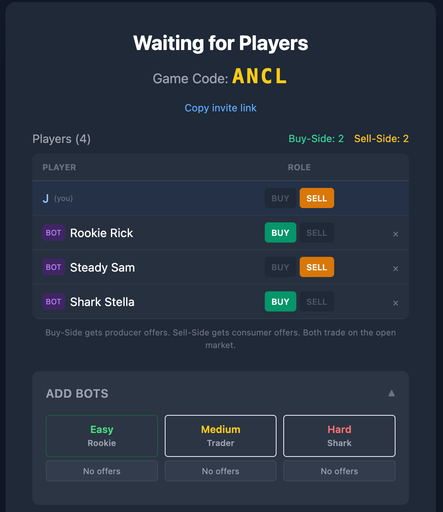
Waiting room with buy/sell role assignment, bot controls, and game settings
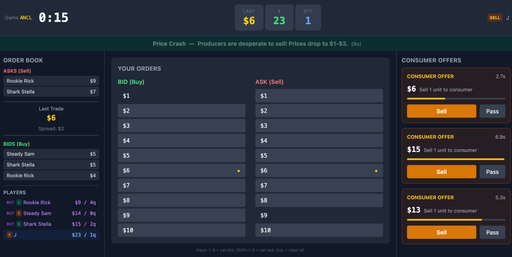
Live gameplay with price chart, fair value line, and market event banner
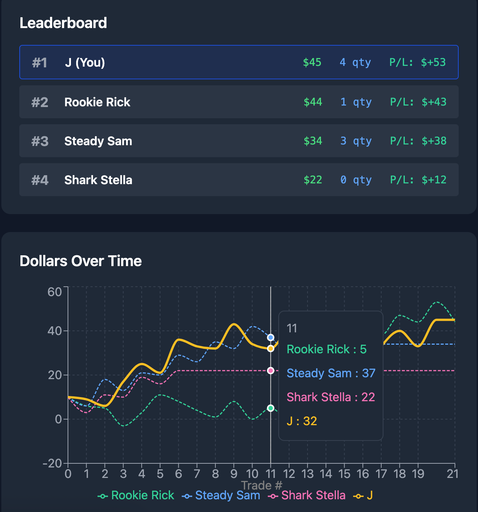
Order book, bid/ask sliders, private offers, and trade log
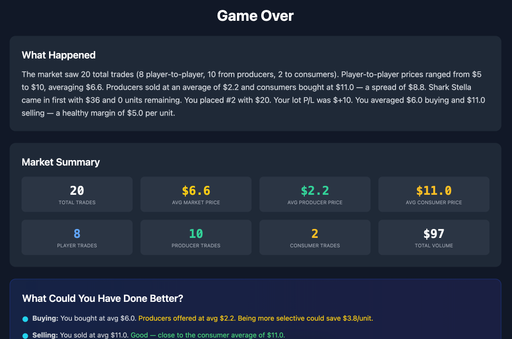
Post-game analysis with market stats, narrative, and spread comparison
Key Features
Interactive Tutorial
New players can learn through an 11-step guided walkthrough that simulates a complete game: accepting offers, setting prices, watching trades execute, and understanding spreads.
Buy-Side & Sell-Side Roles
Players are divided into buy-side (source from producers) and sell-side (sell to consumers). Neither side can complete the cycle alone — they must trade on the open market.
Random Market Events
Supply shortages, demand surges, price crashes, price spikes, market halts, and bonus rounds arrive randomly, teaching how real markets respond to shocks.
AI Bot Opponents
Three difficulty levels with event-aware strategies. Bots buy aggressively during price crashes and sell during spikes — just like real traders.
Post-Game Analysis
Auto-generated narrative, spread analysis comparing all players, "what could you have done better" insights, lot-by-lot P&L, and market-wide statistics.
Challenges & Lesson Presets
Built-in challenges with pass/fail targets (Tight Spreader, Storm Rider, Zero Inventory) and lesson presets for Price Discovery, Thin Markets, and Volatility scenarios.
18-Term Glossary
In-game glossary explains bid, ask, spread, market maker, FIFO, price discovery, and 12 more terms. Accessible from the lobby and results screen.
Spectator & Share
Watch games in progress, share invite links with one click, see the countdown timer in the browser tab, and reconnect seamlessly if disconnected.
How to Play
- 1Create a game or join one with a 4-letter code. Add AI bots if you want more players.
- 2Accept producer offers on the right panel to acquire inventory at a good price.
- 3Set a bid (price you'll pay to buy) and an ask (price you'll accept to sell) on the price sliders.
- 4When your bid crosses another player's ask (or vice versa), a trade executes automatically.
- 5Sell to consumer offers when they appear at favorable prices to lock in profit.
- 6When time runs out, review your performance and lot-by-lot P&L on the results screen.
Concepts You'll Learn
Bid-Ask Spread
The difference between buy and sell prices is where market makers earn their profit
Price Discovery
Watch how prices emerge organically from the interaction of buyers, sellers, and market makers
Inventory Risk
Holding too much inventory exposes you to price changes — a core challenge of market making
Suggested Lesson Flow
- 1Have students complete the interactive tutorial individually (2 minutes)
- 2Run a Standard round as a group. Discuss: who made money? Who lost? Why?
- 3Review the post-game analysis together — spread comparison, lot P&L, market stats
- 4Try the Thin Market preset — what happens when offers are scarce?
- 5Try Volatility with events on — how do shocks affect prices and strategies?
- 6Challenge students with Tight Spreader or Zero Inventory targets
Perfect For
Classrooms
Teach economics and market structure with a hands-on simulation students actually enjoy
Game Nights
Fast-paced 60-second rounds make for exciting multiplayer competition
Self-Learners
Practice solo against AI bots to build intuition for trading and market dynamics
Ready to Make a Market?
No registration required. Play solo against bots or invite friends.
Play Buy Sell GameHave a project like this one?
We'd be glad to talk through your goals, your constraints, and whether we're the right team for the work.