
Ledger
A real double-entry ledger for household finances — budgets, net worth, automatic bank sync, and an AI assistant that actually understands your books.
Budgeting Apps Guess. Ledger Knows.
Most personal-finance apps are a thin layer over a single running balance — they can tell you what you spent, but not whether your books actually balance, or answer a real question about where money moved between accounts over time. The tools that get double-entry accounting right are built for small businesses, not a household juggling joint checking, savings goals, investments, and a shared budget.
Ledger is a proper double-entry system built for a family instead: every transaction is a balanced journal entry, every account rolls up into real financial statements, and a set of higher-level tools — budgeting, net worth, bank sync, an AI assistant, six named budgeting-framework guides — sit on top of that foundation instead of faking it.
One Screen, the Whole Household
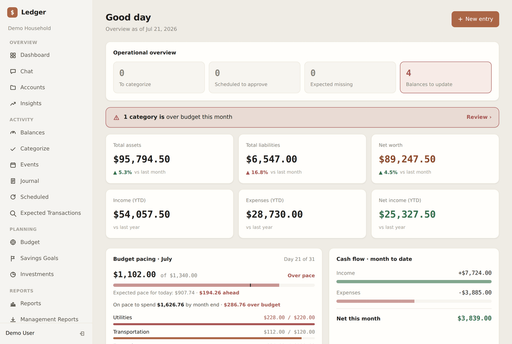
The dashboard surfaces what actually needs attention — transactions waiting to be categorized, scheduled entries due for approval, balances that need a manual update — right alongside net worth, year-to-date income and expenses, budget pacing for the current month, and a live cash-flow summary. Nothing here is guesswork; every number traces back to a balanced journal entry.
Real Accounting, Real Automation
Double-Entry Core
Every transaction is a balanced journal entry across a full chart of accounts — assets, liabilities, equity, income, and expense — with hierarchical balance sheet, income statement, and cash-flow reports.
Automatic Bank Sync
Linked accounts pull new transactions on a schedule via BankSync, land in a review queue with suggested categories, and can be bulk-approved or matched as transfers between your own accounts.
Budgets That Track Pace
Monthly and yearly goals per category, with day-of-month pacing that tells you whether you're on track — not just a total at the end of the month.
Scheduled & Expected Transactions
Recurring entries the ledger posts itself (rent, accruals) are kept distinct from recurring transactions a real bank feed should confirm — each gets the matching workflow.
Net Worth & Insights
Trend charts for net worth, income, and spending by category, with a near-term projection built from your scheduled transactions and an expense waterfall to see where money actually goes.
Management Reports
Typst-typeset PDF financial reports, generated on a schedule or on demand, with narrative summaries and attached charts — the kind of report you'd hand to an accountant.
Budgets That Tell You Where You Stand Today
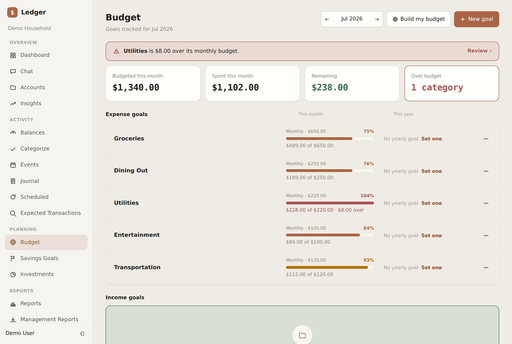
Every expense category can carry a monthly and a yearly goal, and the budget view shows exactly how far into the month you are versus how far into the goal — so an overspent category shows up as a problem on day 12, not a surprise on day 30. A budget-building wizard can suggest goals from trailing spending history, and goals can roll over unused amounts month to month.
A Photo of a Receipt Is a Journal Entry
Snap It, Skip the Typing
Photograph or upload any receipt from any store and an AI reads the date, the total, and every line item off the image — no manual entry, no receipt shoebox.
Split Across the Right Categories
A single big-box run doesn't have to land as one undifferentiated debit. Line items are split across categories automatically, so a $340 Costco trip becomes correctly-categorized grocery, household, and electronics lines.
Matched to the Real Transaction
The receipt is matched to the bank transaction already sitting in the review queue, so what you bought and what hit your account are tied to the same balanced entry — not two disconnected records.
Eleven Guides, Not Just for Money
It started as personal-finance frameworks — conscious spending, step-gated debt payoff, a financial order of operations, FIRE — each mapping your real accounts onto that framework's buckets or steps, opt-in and account-by-account, with nothing silently assumed. Ledger now applies the same idea beyond money: a household-goals tracker, a meal planner, a sleep system, an exercise-consistency guide, a time tracker. Eleven guides in all, each with its own name and its own read on your data — Cairn keeps a home-renovation goal from quietly stalling, Dusk turns a sleep log into a system instead of a mystery, and Wallop is the blunt one — a monthly reality check, no vibes.
Life Doesn't Fit in a Ledger. Now It Doesn't Have To.
Alongside the double-entry books, Daybook is a simple tracker for anything that isn't money — a running number you log, or a list of things you open and close. Each track is private to you or shared with the household, your choice. A family typically starts with a few: workouts logged in minutes, time with the kids, a running todo list, a shared chore list — but a track can be created for anything worth keeping a record of.
An Assistant That Can Actually Query Your Books
Chat, Backed by Real SQL
The AI chat assistant answers questions by running read-only SQL against a dedicated, permission-locked database role — not by guessing from a summary — so answers about your own finances are actually correct.
AI-Assisted Categorization
Incoming bank transactions get suggested categories and transfer matches, so reviewing a week of activity is a handful of confirmations instead of manual data entry.
Passkey-First Security
Authentication runs through pk-idp, our own passkey-based identity provider — invite-only, no passwords anywhere in the system, and no public signup.
Books that actually balance.
Want double-entry accounting built for how your team or household actually works?
Talk to usHave a project like this one?
We'd be glad to talk through your goals, your constraints, and whether we're the right team for the work.